DataStory: Aviation Safety
Noelia Manion
Less than 0.0001% of commercial flights result in an accident, based on global safety data.
This DataStory project will explore aviation safety trends in the United States using incident and accident data spanning from 2008 to the present. The goal is to understand not just how often aviation events occur, but where, when, and under what conditions they are most likely to happen. While major air disasters tend to dominate public attention, the majority of reported aviation events are smaller incidents that result in no injuries and end in safe landings. These reports still matter, as they reveal patterns in aircraft type, phase of flight, environmental conditions, and operational factors that contribute to risk.
Through a series of interactive dashboards, this site will examine long term safety trends, aircraft characteristics, geographic patterns, flight phases, environmental conditions, and investigative findings. Together, these visualizations tell a broader data story about how aviation safety has evolved, how reporting practices shape the data, and where vulnerabilities still exist. This project also places the data in real world context by connecting trends to well known aviation incidents and the safety changes that followed them.
Slides
A DataStory of
U.S. Aviation Incidents and Safety
Commercial aviation is often framed through rare, catastrophic disasters that dominate public memory. In reality, aviation safety is shaped far more by everyday incidents than by headline making crashes. This project explores U.S. aviation incident and accident data from 2008 to the present to understand long term safety trends, contributing factors, and where risk most often appears. Rather than focusing only on fatal outcomes, this analysis treats incidents as signals. Even minor events reveal patterns in aircraft use, operational environments, and human decision making.
By visualizing incidents across time, aircraft characteristics, geography, flight phase, and reported findings, this DataStory shows that aviation safety is not defined by a single cause or moment. Instead, it is the result of layered systems, aging aircraft fleets, routine operations, and gradual safety improvements that together shape modern flight.
I. Safety Trends Over Time

At a high level, aviation safety has steadily improved. Since 2008, incidents have shown a clear downward trend, with a significant drop during 2020 and 2021 due to the COVID-19 shutdown of air travel. Injury outcomes follow the same pattern, with fatal, serious, and minor injuries all decreasing over time.
While the pandemic years are notable, the overall trend reflects gradual safety improvements rather than sudden changes. Better training, technology, and reporting systems seem to lower both the frequency and severity of incidents, even as air traffic volumes recover.

Overlaying major aviation events onto this timeline gives context. High-profile accidents, such as Air France 447 and the Air Canada 759 taxiway overflight, did not change overall trends. However, they prompted specific safety changes that strengthened the entire system.
II. Aircraft and Risk Concentration
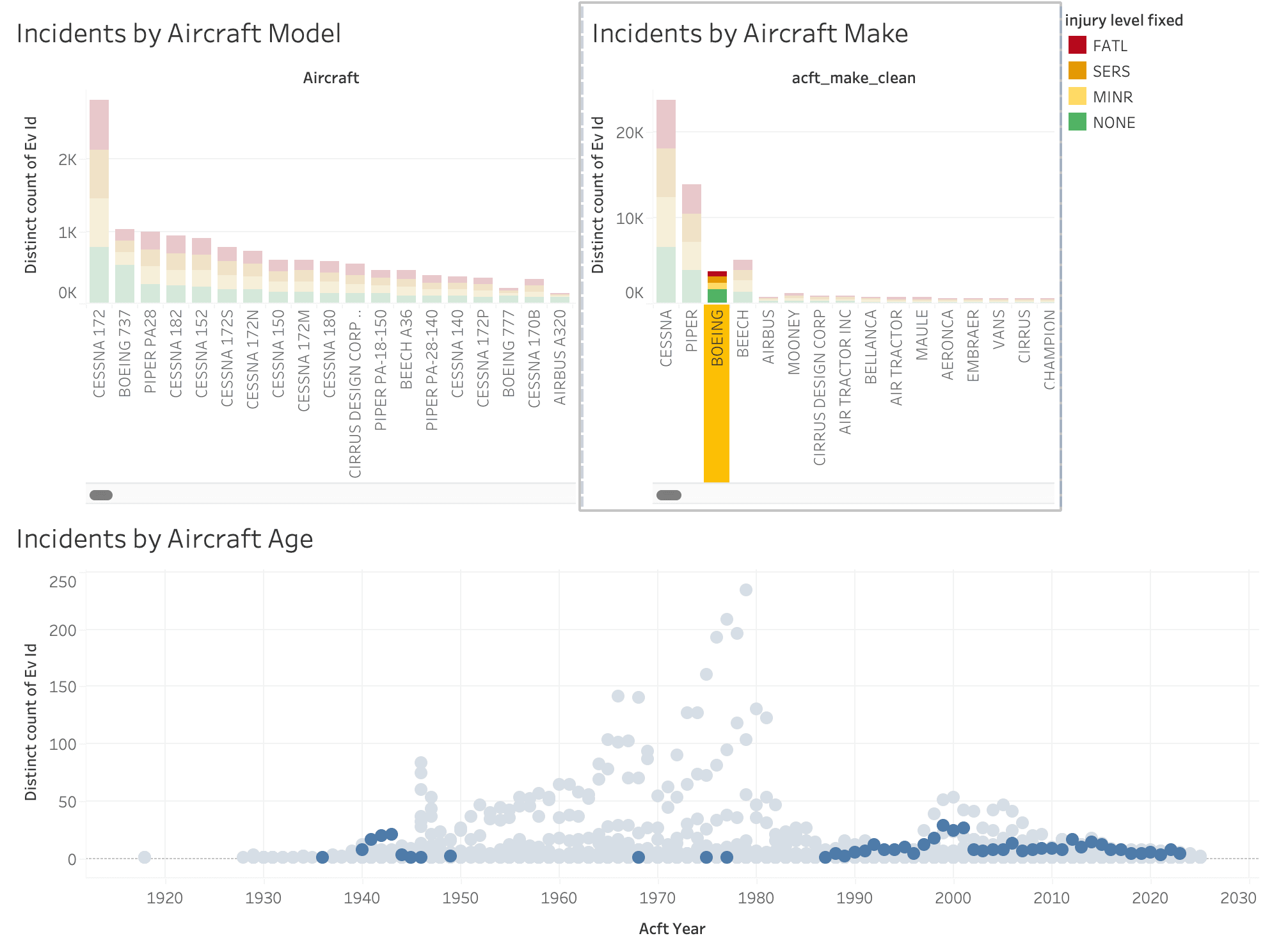
Not all aircraft contribute equally to incident counts. The data shows that small, widely used aircraft top the list of reported incidents. Models like the Cessna 172 appear most frequently, followed by other general aviation aircraft and fewer commercial models. Breaking down incidents by aircraft age reveals another pattern. Aircraft made between approximately 1960 and 1980 have higher incident counts than newer fleets. This matches the ongoing use of older, privately owned aircraft that may lack modern safety technology and operate under less regulated conditions.
Together, these visuals show that incident volume reflects exposure and usage as much as mechanical failure.
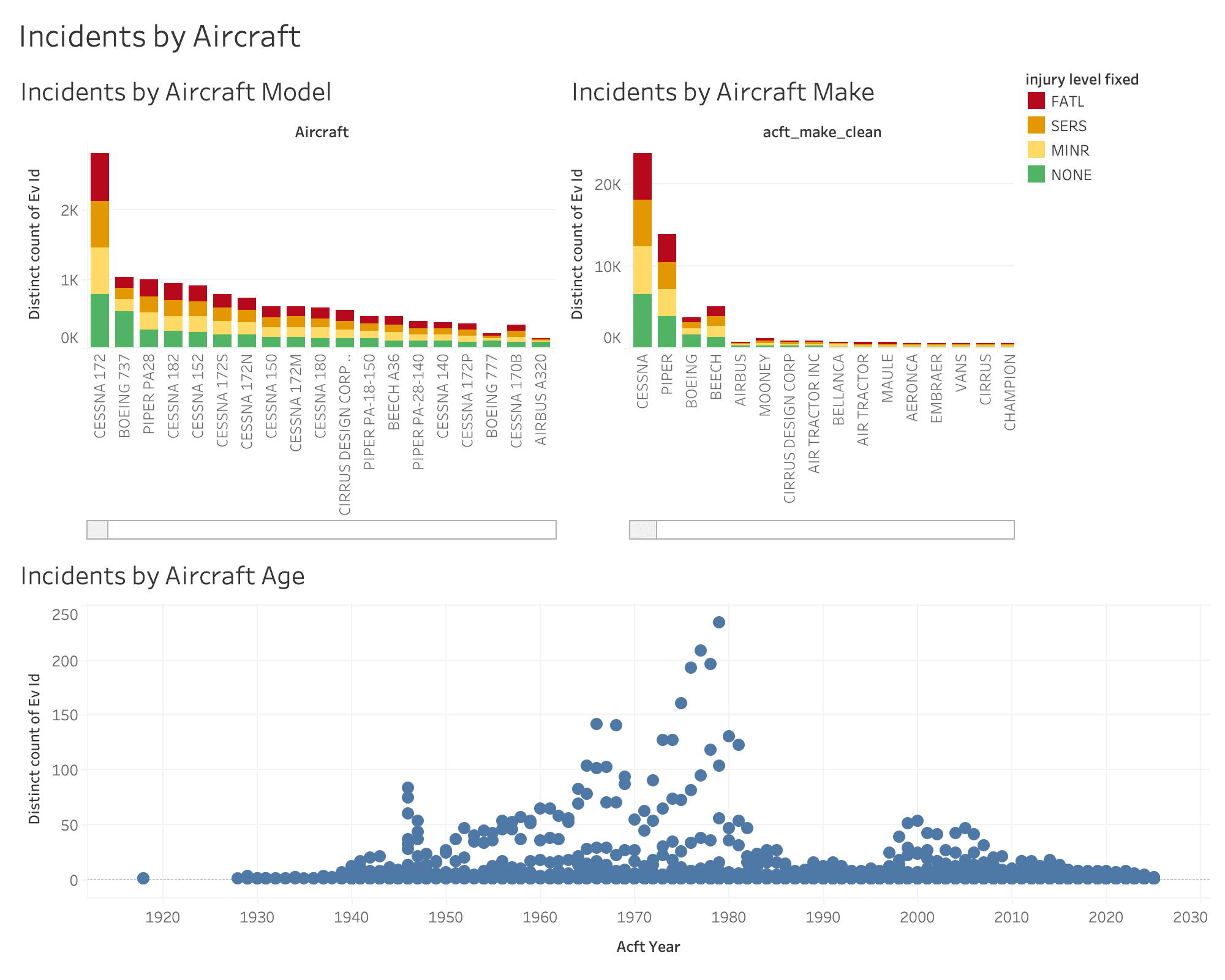
This is made even more clear through the utilization of highlighting within Tableau: Highlight "Cessna" (left) yields much different results than highlighting "Boeing" (right) when it comes to aircraft age and incident count.

III. Where Incidents Occur

Geographically, incidents cluster heavily in the United States, which makes sense given the data source. Departure and destination maps are very similar, reinforcing the idea that most incidents happen during routine domestic operations rather than unusual routes. The similarity across maps suggests that location alone is rarely the main risk factor. Instead, risk is shaped by how aircraft are used in these areas.
IV. Phase of Flight and Operating Conditions
The phase of flight reveals a more detailed story. Landings account for the highest number of incidents, but these tend to have lower injury severity. Incidents during the cruise phase happen less often but are far more severe, often leading to fatalities. Environmental and light conditions add context to these risks. Most incidents occur during daylight and clear weather, showing that exposure and traffic volume matter more than darkness or poor weather alone.

V. Understanding Findings

Reported findings show that aircraft-related issues account for over half of primary causes, followed by environmental and personnel factors. However, many incidents involve multiple findings, highlighting that aviation incidents rarely stem from a single failure. This supports the idea of aviation as a system where mechanical, human, and environmental elements come together.
VI. Conclusion
Aviation safety is not shaped not by isolated. Rather, it is shaped by patterns across thousands of everyday incidents. This DataStory shows a system that is improving, but still faces challenges from aging aircraft, routine operations, and layered risk factors. By focusing on common occurrences instead of rare catastrophes, the data emphasizes where safety interventions have worked and where further attention is needed.
It is understandable that for many, flying can feel scary, unknown, and risky. But the truth is, it is the safest means of travel available, and that is due to extensive safety measures. Through my DataStory, I've aimed to show how aviation safety has improved over time, as well as make it more clear that most incidents are small, go unnoticed, and are easily mitigated. Bigger accidents, by large, are due to human error.
Just remember, out of the thousands of commercial flights that depart and arrive globally every single day,
Less than 0.0001% of commercial flights result in an accident, based on global safety data.
VII. References
